
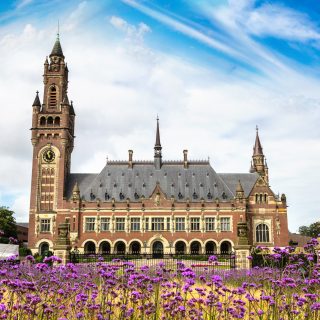
On 12th of November, the City Law School hosted a seminar focused on the challenges and limitations faced by international courts and their ability to deliver justice during times of global crisis.
The speakers were Marco Longobardo, a reader in International Law at the University of Westminster, and Alonso Gurmendi-Dunkelberg, an LSE Fellow in Human Rights in the Department of Sociology.
The discussion focused on the capacity of the International Criminal Court (ICC) and the International Court of Justice (ICJ) to address legal challenges and uphold accountability. Speakers highlighted how the ongoing conflicts between Israel and Palestine and Russia and Ukraine have tested the ability of these courts to provide just solutions amid international crises.
Expansion of the Scope of International Courts
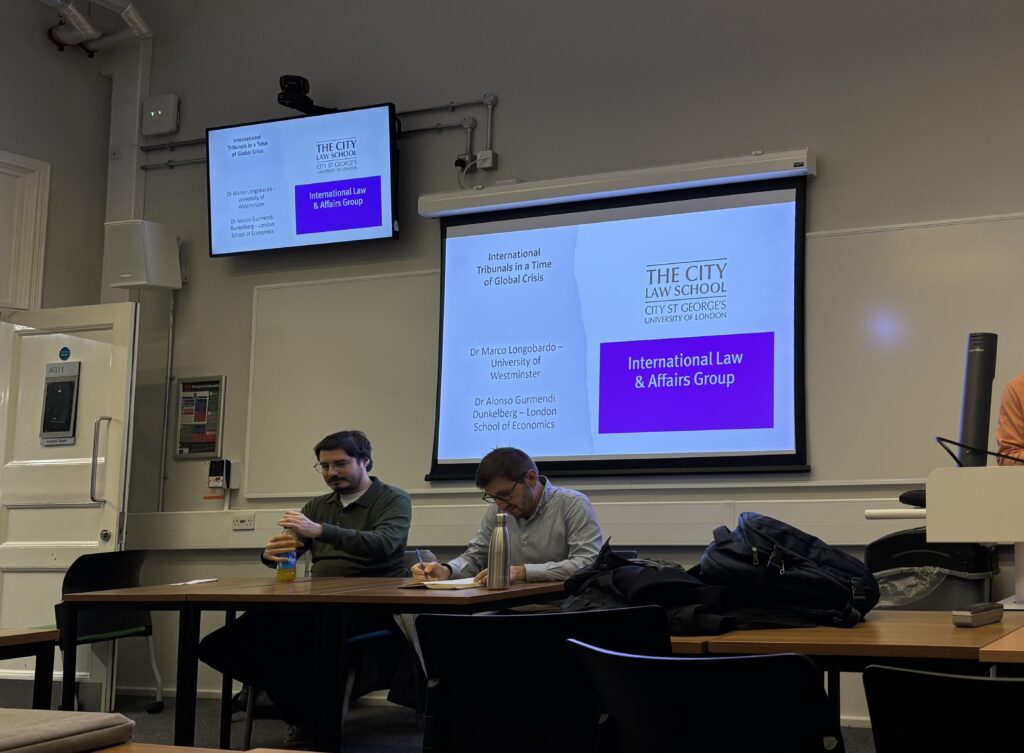
Dr Marco started the discussion by stressing that the ICJ has never been as busy as it is today. He remembered how, in the past, it was expected that law students should know the details of all the cases before the Court, and stated that today this would be impossible. The cause of this was pinpointed to be the expansion of the International Court’s scope.
In the past, States were said to be reluctant to give consent to the Court, especially after the ‘South West Africa’ case in 1966, where the ICJ’s reputation was damaged after it avoided ruling on the merits. Today, however, he stated that States seem to have more confidence in the Court to solve international conflicts and intervene in cases of genocide, torture, among others.
The turning point for such a change, in his opinion, was the 2012 case of Belgium v Senegal, where the focus shifted from bilateral disputes to those brought by states not directly affected (Questions relating to the Obligation to Prosecute or Extradite (Belgium v. Senegal)).
Another important development is that the ICJ has been proactive in issuing advisory opinions, for example, the 2024 advisory opinion on the illegality of Palestine’s ratification and its consequences for third-party States.
Whilst he believes these advisory opinions can be helpful, Dr Marco argued that this expansion of the ICJ’s scope is shifting its role towards that of a global forum. He believes some of the side effects associated with this can include delays in the delivery of judgments and a decline in the overall quality of judgments.
International Law & Colonialism as Its Underlying Structure:
Dr Alonso began by stating that, contrary to what he was told in the early years of his career, he tends to reject the premise that the law is a set of neutral principles. In supporting this argument, he mentioned the history of international law and Anthony Anghie’s work on how international law was a crucial tool in enabling the colonisation of the Americas, for example.
He also mentioned that it is important to keep these factors in mind when analysing organisations such as the ICC and the ICJ, as the ground structure from which the rules of international law have been constructed can sometimes be deemed not very noble or selfless. He pointed this out as one of the underlying issues in producing accountability.

Alonso also criticised the sometimes narrow approach the ICJ takes when interpreting the Genocide Convention, and the decision to create a separate tribunal to prosecute the war crimes committed in Ukraine. However, he still believes that the ICJ and ICC play an important role as strategic tools that States can use, through judgments and advisory opinions, to secure emancipation, liberation, and equality.
How to get involved
If, like me, you’re also a law student interested in international law and the role global issues play in it, Dr Alonso has a YouTube Channel that can be a great starting point for staying informed. At the end of the event, I also had the opportunity to ask Alonso if he had any tips for students who are interested in the subject and wanted to get more involved, and his answer was:

“I believe in the power of collective endeavours, so get together with like-minded people and go after the world you want to create”.
Big thanks to Francine Juarez Bulio for this review. She is a member of the Lawbore team and a second year LLB student, originally from Brazil. Here’s what she says about herself:
“I have always been interested in Law and actually started a Law degree back home, but I wasn’t able to complete it before moving to England at the age of 19. I hope to work with human rights law one day. Beyond my studies, I really enjoy reading and trying out new coffee shops around London.”