

ChambHer is a new community made for women of colour aspiring to become barristers. It was founded by Tonya Bailey, who is currently a legal assistant aspiring to be a Barrister herself. ChambHer aims to significantly increase diversity at the Bar, particularly for Black and Asian women, who are currently underrepresented in the field. It is to provide support for women at the start of their legal career. ChambHer exists to radically expand access to the Bar by removing the barriers of silence, gatekeeping and elitism.
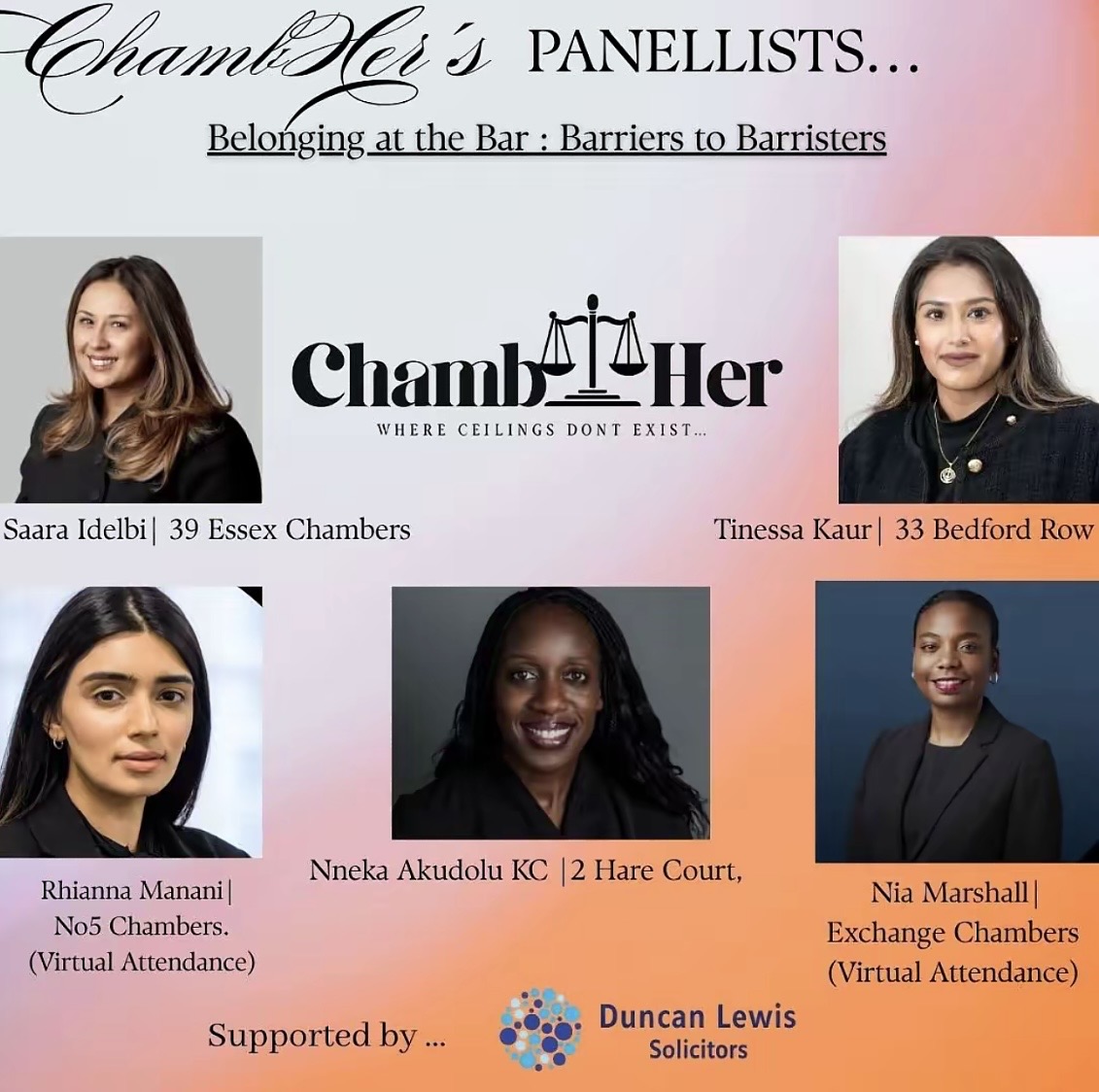
ChambHer hosted their second event, ‘The Belonging at the Bar: Barriers to Barristers’ on the 26th October 2025. Central to the event was emphasising the importance of community at the Bar and for women of colour being able to freely take up space there. There were five formidable panellists.
- Nneka Akudolu KC (2 Hare Court), specialises in Crime
- Saara Idelbi (39 Essex Chambers), specialises in Public plus
- Tinessa Kaur (33 Bedford Row), specialises in Crime
- Nia Marshall (Exchange Chambers), specialises in Personal Injury and Employment
- Rhianna Manani (No5 Chambers), specialises in Family
A powerful takeaway was hearing the panellists emphasising that the journey may be longer than you envisage but that you should not give up. Tinessa, for example, had made 9 rounds of pupillage applications and had finally completed pupillage in January 2025. Saara highlighted that sometimes you should be flexible in your plans, accepting that you may need to change your strategy in order to gain the experience required. Below I summarise responses to some of the questions posed.
As a woman of colour trying to break into law, how do you balance being visible at the Bar without being tokenised?
Panellists highlighted that social media has helped build a community where they can share their journeys, and more easily collaborate. That is a great way to be noticed. This age and this generation have a golden opportunity to get their voice out.
By speaking to Chambers and barristers, you can quickly ascertain that you are not being hired because you tick a specific box, but because you have the skills and attitude to be a barrister. This is clear through through communication and engagement.
It’s worth remembering too that the circle you’ll be operating in is quite small; you’ll be coming across the same people regularly. So, it is important to focus on your visibility in that circle and get involved. You may not get every opening you apply for, but you should still throw yourself at everything, as it increases your opportunities.
What has your experience been like navigating your career and identity as a woman of colour in your individual area of practice, and the Bar in general?
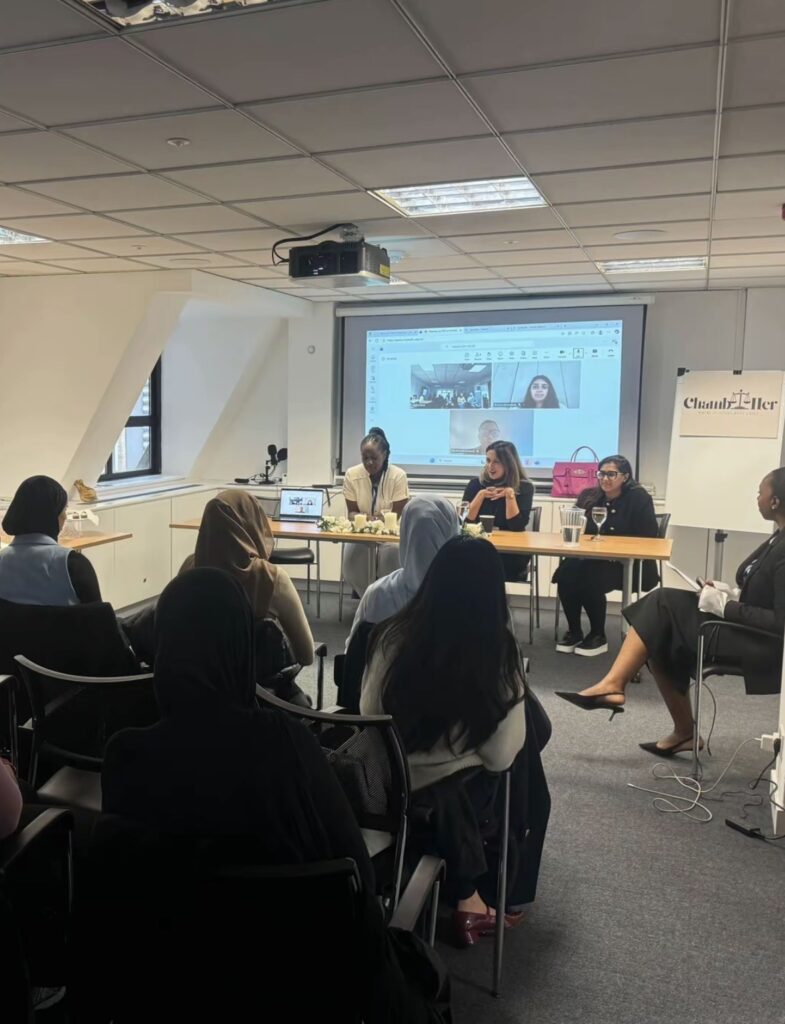
Participants cited that it was difficult in the beginning, when you are forging your way without a community. Nneka was called to the Bar in 2002, and in March 2021 made a successful first application for Silk. Nneka is the sixth black female silk in the entire country, ever! As you become more senior and do more serious cases, you will find yourself in spaces where the judges and the majority of the barristers defending other clients will be male or white. In those circumstances, you have to hold your space. You need to be the person who knows the most about any cases at any given time, so you know you should be there. There is this sense of professional pride, where you do not want anyone to know the case better than you do.
The panel touched on outward appearance too, making clear that you can maintain your professionalism whilst still looking good. They noted that this will help boost your confidence and how you feel in court, referring to various studies where make up wearing is seen to give more authority and competence. This was acknowledged as “a bit silly” but an accomodation worth making, and similar to how you adapt your submissions for the jury, versus the judge, versus our client. They touched on the gown and wig too, taking comfort in its ability to reduce the likelihood of being recognised outside of the court context (note the updated guidance from the Bar Council on this – July 2025).
For international students schooled elsewhere, how is it navigating and having to verify yourself at such an early stage of your career?
You may often be told to opt for the route as a solicitor, as Chambers will not be able to accommodate an international applicant or an immigrant. The panel acknowledged this will be deflating but recommended to keep pushing on. When making pupillage applications, you need to explain your qualifications to the UK equivalent, as some Chambers will not research the grading system of your country. Once you do that, the person marking your script can better value your application. A simple sentence will suffice.
Ask yourself: What is your USP? What sets you apart? What makes you different? What is it that you are doing?
Use your life experiences and be vulnerable about who you are, regardless of how untraditional your life and past may be; use your experiences to your advantage. Tinessa set up an Anti-Gang Project (Cut it out) and visits schools, talking about her personal experiences and how individuals can change their lives at any point. This allowed her to gain experience with criminal exploitation whilst developing her advocacy skills. Put yourself into the world, but do not feel the need to overexpose who you are; find the right balance and the right target audience. The panel highlighted that a full-blown analysis is not always needed, sometimes a small takeaway is sufficient to get the engagement (and confidence) you need from your wider network.
The final thought from a terrific evening was:
Rejection is not the end! Rejection is redirection!
Neha Mohit is currently studying on the BVS LLM course, and is looking to specialise in the commercial field. She has a passion for journalism, and believes it is essential to keep updated on the legal world, whether it be of the changes or opportunities available. Neha is a member of this year’s Lawbore Journalist Team.